Friday, January 30, 2009
Non Aggressive Red tailed hawk

The Red-tailed Hawk is carnivorous, and an opportunistic feeder. Its diet is mainly small mammals, but it also includes birds and reptiles. Prey varies with regional and seasonal availability, but usually centers on rodents. Additional prey (listed by descending likelihood of predation) include lagomorphs, shrews, bats, snakes, waterfowl, fish, crustaceans and insects.
Wild beast
The ungainly gnu earned the Afrikaans name wildebeest, or "wild beast," for the menacing appearance presented by its large head, shaggy mane, pointed beard, and sharp, curved horns. In fact, the wildebeest is better described as a reliable source of food for the truly menacing predators of the African savanna: lions, cheetahs, wild dogs, and hyenas.

Their habitat comprises the grassy plains and open woodlands of central, southern, and eastern Africa, particularly the Serengeti in Tanzania and Kenya. They travel in large herds and are active day and night, grazing constantly.
Source: National Geographic.org
Red-eyed Tree Frog

The Red-eyed Tree Frog (Agalychnis callidryas) is a small-sized tree frog, reaching lengths of about 5 to 7 centimeters (3 inches), native to Neotropical rainforests in Central America. They are not poisonous and rely on camouflage to protect them. During the day, they remain motionless with their colorful parts hidden. Thus, they appear almost completely green, and well hidden among the foliage.
source:Wikipedia
Friday, January 23, 2009
Chital

Most beautiful eagle

The sea eagle is white on the head, rump and underparts and dark grey on the back and wings. In flight the black flight feathers on the wings are easily seen when the bird is viewed from below. The large, hooked bill is grey with a darker tip, and the eye is dark brown. The legs and feet are cream-white, with long black talons (claws). Young Sea-eagles are brown when juveniles then gradually come to resemble adults, acquiring the complete adult plumage by their fourth year. Birds form permanent pairs that inhabit territories throughout the year. Their loud "goose-like" honking call is a familiar sound, particularly during the breeding season. They chose the tallest tree to nest, and even sometimes man-made pylons.
Tuesday, January 20, 2009
Intelligent - African Gray Parrot

Irene Pepperberg's extensive research with captive African greys, especially the one known as Alex, have provided evidence that these parrots are capable of associating human words with their meanings, at least to some extent, though these conclusions are disputed. Ambitious claims of language use have been made for another African grey, N'kisi, who has a vocabulary of around a thousand words and speaks in sentences.
Fox Squirrels

Fox Squirrels are strictly diurnal, non-territorial, and spend more of their time on the ground than most other tree squirrels. They are still, however, agile climbers. They construct two types of homes called "dreys", depending on the season. Summer dreys are often little more than platforms of sticks high in the branches of trees, while winter dens are usually hollowed out of tree trunks by a succession of occupants over as many as 30 years. Cohabitation of these dens is not uncommon, particularly among breeding pairs.
Monday, January 19, 2009
Geographic cone snail

The incredibly toxic venom of the geographic cone snail has to be strong enough to paralyze instantly. Otherwise, the fish it preys on would swim away to die, and the slow-moving gastropod would have nothing for its efforts.
Indigenous to the reefs of the Indo-Pacific, geographic cones grow to about 6 inches (15 centimeters) in length and have intricately patterned brown-and-white shells highly prized by shell collectors.
The geographic cone is the most venomous of the 500 known cone snail species, and several human deaths have been attributed to them. Their venom, a complex concoction of hundreds of different toxins, is delivered via a harpoonlike tooth propelled from an extendable
Sunday, January 11, 2009
Milk snakes don't drink milk
 Milk snakes eat a lot of different rodents.Milk Snakes are much more opportunistic eaters than the fox snake or corn snake. They have been known to consume a variety of animals including rodents, eggs, birds, reptiles, amphibians, and invertebrates. Nevertheless the diet of an adult milk snake still primarily consists of rodents. They are nocturnal eaters and are often found during the day in old barns and under wood.
Like other members of the king snake family, the milk snakes sometimes eat other snakes, and do have at least some immunity to their venom.
Saturday, January 10, 2009
Burying beetles
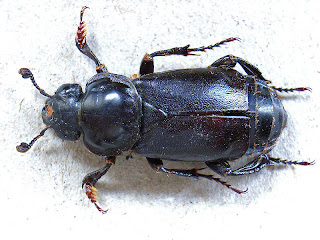
The prospective parents begin to dig a hole below the carcass. While doing so, the beetles cover the animal with antibacterial and antifungal oral and anal secretions, slowing the decay of the carcass and preventing the smell of rotting flesh from attracting competition. The carcass is formed into a ball and the fur or feathers stripped away and used to line and reinforce the crypt, where the carcass will remain until the flesh has been completely consumed. The burial process can take around 8 hours. Several pairs of beetles may cooperate to bury large carcasses and then raise their broods communally.
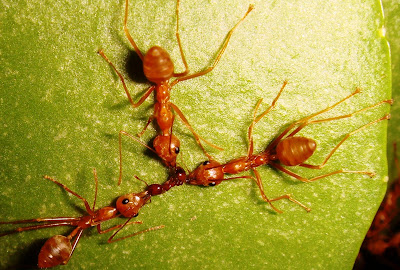
Red-ant dismembered by weaver ants
Friday, January 9, 2009
Red-headed rock agama
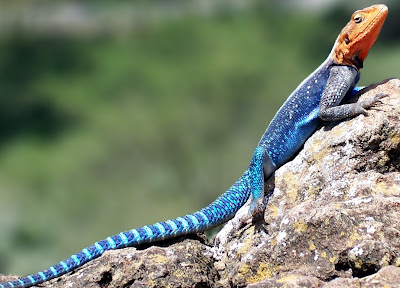 The females and juveniles are always more cryptically marked. This lizard can be climbing rocks and walls.
The dash-and-dot goatfish
 Above the stripe, the body has a yellowish tint. Dash-and-dot goatfish from deeper water will usually have red stripes and spots. They can reach a maximum length of 60cm.
Wednesday, January 7, 2009
Largest and oldest known chestnut tree in the world
 Guinness World Records has listed it for the record of "Greatest Tree Girth Ever", noting that it had a circumference of 57.9 m (190 ft) when it was measured in 1780. Above-ground the tree has since split into multiple large trunks, but below-ground these trunks still share the same roots.The tree's name originated from a legend in which a queen of Aragon and her company of one hundred knights, during a trip to Mount Etna, were caught in a severe thunderstorm. The entire company is said to have taken shelter under the tree.
Fearless Hood Mockingbird
 Hood Mockingbird is found in dry forests and is omnivorous, though it primarily is a carnivore or scavenger. The species has a highly territorial social structure and has no fear of humans.The bird is extremely aggressive and curious, and has no fear of humans whatsoever. The bird will chase after tourists in search of food, drink, or any unusual object. In some cases, the species will attempt to obtain water from tourists by pecking at their water bottles.
The birds have a strong social structure organized into family groups. Highly territorial, these groups will cooperatively hunt within their area as well as defend it against other groups. Lower-ranking members of the group will assist in caring for the young.The bird is considered to be vulnerable in the wild by BirdLife International due mainly to its limited area.
Sunday, January 4, 2009
Worlds largest fish
 There are unconfirmed reports of sharks lying still, upside down on the surface to allow divers to scrape parasites and other organisms from their bellies. Divers and snorkelers can swim with this giant fish without any risk apart from unintentionally being struck by the shark's large tail fin.
Sea Dragon

The Leafy Sea Dragon has a long, pipe-like snout that it uses to feed. It primarily eats crustaceans including plankton and mysids, but its diet also includes shrimp and other small fish. It catches its prey using its camouflage ability. Leafy sea dragons oddly enough do not have teeth, which is rare amongst animals that eat small fish and shrimp.
The Leafy Sea Dragon is a cousin of the pipefish and belongs to the family Syngnathidae, along with the seahorse. The Leafy Sea Dragon differs from the seahorse in its appearance, form of locomotion, and the Leafy Sea Dragon's inability to coil or grasp things with its tail. A related species is the weedy sea dragon, which is multi-coloured and grows weed-like fins and can be much smaller than the leafy sea dragon. In the November 2006 issue of National Geographic magazine, marine biologist Greg Rouse is reported as investigating the DNA variation of the two sea dragon species across their ranges.
Saturday, January 3, 2009
Gila monster's venom

Frill-necked lizards - one meter length

Dangerous yellowjacket

Friday, January 2, 2009
Weaver ants as natural biocontrol agents against agricultural pests

Ant mimicking spiders

Spiders in this genus are commonly called "antmimicking spiders", although there are many other spiders that mimic ants. Colors vary from black to yellow, depending on the mimicked ant species. One African species was observed to mimick one species when immature, and another as an adult
Thursday, January 1, 2009
Pouched Frog

This species formerly experienced declines, however it has recovered.
Wednesday, December 31, 2008
Large Bee Fly

Wood Scorpion

Tuesday, December 30, 2008
Only spice to come from coniferous trees
 A juniper berry is the female seed cone produced by the various species of junipers. It is not a true berry but a cone with unusually fleshy and merged scales, which give it a berry-like appearance. The cones from a handful of species, especially Juniperus communis, are used as a spice, particularly in European cuisine, and also give gin its distinguishing flavour. According to one FAO document, juniper berries are the only spice derived from conifers, though tar and inner bark (used as a sweetener by Apache cuisines) from pine trees is sometimes considered a spice as well.The flavour profile of young, green berries is dominated by pinene; as they mature this piney, resinous backdrop is joined by what McGee describes as "green-fresh" and citrus notes. The outer scales of the berries are relatively flavourless, so the berries are almost always at least lightly crushed before being used as a spice. They are used both fresh and dried, but their flavour and odour is at their strongest immediately after harvest and decline during drying and storage.
Monday, December 29, 2008
150 years to reach maturity

Sunday, December 28, 2008
Stinkpot turtles release a musky smell

Their common names are derived from the scent glands located just under the rear of their shell, which allows them to release a foul musky odor to deter predation.
Saturday, December 27, 2008
Over 1000 individual flowers around its mid axis

Banksia spinulosa was introduced into cultivation in the United Kingdom in 1788 by Joseph Banks who supplied seed to Kew, Cambridge Botanic Gardens and Woburn Abbey among others; var. collina followed in 1800 and var. cunninghamii in 1822. It has proven a highly ornamental and bird-attracting plant in cultivation. In general, all forms prefer sandy, well-drained soils with sunny aspect, though some local forms hailing from Wianamatta shales may tolerate heavier soils. It is resistant to dieback, like most eastern banksias. As it grows naturally on acid soils, Banksia spinulosa is particularly sensitive to iron deficiency. Known as chlorosis, it manifests as yellowing of new leaves with preservation of green veins, and occurs when the plant is grown in soils of higher pH. This can also happen where soil contains quantities of cement, either as landfill or building foundations, and can be treated with iron chelate or sulfate.Regular pruning is important to give the plant an attractive habit and prevent it from becoming leggy. It has over 1000 flowers around its mid axis
Friday, December 26, 2008
Bird that swims for 2 hours after hacthing

Thursday, December 25, 2008
California Clapper Rail - Rarely flies but can swim

Wednesday, December 24, 2008
Rocking slug

can even be white. The general trend is for a darker pigmentation the farther north the species
is found. The classification of brown-coloured and rust-coloured "black" slugs is somewhat
disputed; the brown variation is sometimes considered to be a separate species, Arion rufus
(Red Slug). Young specimens of black slug do have a brown colour, which is later lost if and
when the slug changes color to the mature state.The slug covers itself in a thick foul-tasting mucus which serves as both protection against
predators as well as a measure to keep moist. It is somewhat difficult to wash off.The black
slug is mainly nocturnal and avoids exposure to sunlight. It is omnivorous, eating carrion,
fungi, and vegetation (living and decaying). The slug prefers moist conditions, such as lawns,
making it an unwelcome sight for homeowners. This moist environment is essential for the
terrestrial locomotion of the slug to function.The mucus of the slug is highly distasteful to many animals. However, this slug does have
some natural predators, including the hedgehog, badger, shrew, mole, mouse, frog, toad,
snake, carnivorous beetle, and some birds. When picked up or touched, the black slug will
contract to a hemispherical shape and begin to rock from side to side. This defensive
behaviour confuses predators, and is unique in the Arionidae family
Mouse that gives birth to 40-60 offspring in a year

Tuesday, December 23, 2008
Eagle that barks and screams
 Bateleur is a common resident species of the open savanna country in Sub-Saharan Africa. It nests in trees, laying a single egg which is incubated by the female for 42 to 43 days, with a further 90 to 125 days until fledging. Bateleurs pair for life, and will use the same nest for a number of years. Unpaired birds, presumably from a previous clutch, will sometimes help at the nest.An immature domestic BaleteurThe Bateleur is a colourful species with a very short tail (ecaudatus is Latin for tailless) which makes it unmistakable in flight. The adult male is 60 to 75 cm (24 to 30 in) long with a 175 cm (5.75 ft) wingspan. He has black plumage except for the chestnut mantle and tail, grey shoulders, and red facial skin, bill and legs.The female is similar to the male except that she has grey rather than black secondary flight feathers. Immature birds are brown with white dappling and have greenish facial skin. It takes them seven or eight years to reach full maturity.The eagle hunts over a territory of 250 square miles a day. The prey of this raptor is mostly birds, including pigeons and sandgrouse, and also small mammals; it also takes carrion.The Bateleur is generally silent, but on occasions it produces a variety of barks and screams."Bateleur" is French for "tight-rope walker". This name describes the bird’s characteristic habit of tipping the ends of its wings when flying, as if catching its balance.In some countries, the Bateleur is occasionally known as the "Conifer Eagle" or even "Pine Eagle", since its feathers somewhat resemble a conifer cone when it fluffs itself up.

Bird that attacks known predators
 The Puerto Rican Spindalis are usually found in pairs but may travel in small flocks. These birds
also engage in a behavior called mobbing. This is when a flock of birds, from one or more
species, attack a known predator, usually to defend their eggs or hatchlings. Such behavior
has been observed being directed against the Puerto Rican Boa by immature Puerto Rican
Spindalis. The Puerto Rican Spindalis exhibits sexual dimorphism with males being brightly
colored and females being dully colored. Males are green colored above with an orange neck
and chest. They have a black head with two white stripes running across it, with one above
and one below the eyes. The tail and wings are gray to black with small white stripes at the
tips. In contrast, the female is a dull olive-green color with slightly noticeable white stripes. It
is widely distributed throughout the island and is an important part of the Puerto Rican
ecosystem because of its help in seed dispersal and plant reproduction. The Puerto Rican
Spindalis is also the national of the United States Commonwealth of Puerto Rico.
Monday, December 22, 2008
Bat ray in large numbers, while more recently it is mostly taken by oyster growers who mistakenly believe it feeds on their oysters

The plant that catches frog, rat and lizards

family. It is endemic to Mount Kinabalu and neighbouring Mount Tambuyukon in Sabah,
Malaysian Borneo. N. rajah grows exclusively on serpentine substrates, particularly in areas of
seeping ground water, where the soil is loose and permanently moist. Nepenthes rajah, the
most famous of all pitcher plants, produces traps up to 40 cm in height and has been known to
catch prey as large as rats, frogs and lizards. MYTH- Another myth surrounding this species is that it occasionally catches small monkeys
and other large animals in its pitchers. Such tales have persisted for a very long time, but can
probably be explained as rodents being mistaken for other species. It is interesting to note
that one common name for Nepenthes plants is 'Monkey Cups'. The name refers to the fact
that monkeys have been observed drinking rainwater from these plants. Thus, in a sense, this
mythology may have some basis in fact.
Sunday, December 21, 2008
Dancing clownfish

Largest freshwater turtle - Dinosaur of the turtle world

Found almost exclusively in the rivers, canals, and lakes of the southeastern United States, alligator snappers can live to be 50 to 100 years old. Males average 26 inches (66 centimeters) in shell length and weigh about 175 pounds (79.4 kilograms), although they have been known to exceed 220 pounds (100 kilograms). The much smaller females top out at around 50 pounds (22.7 kilograms).
Alligator snappers spend most of their lives in water, the exception being when females trudge about 160 feet (50 meters) inland to nest. They can stay submerged for 40 to 50 minutes before surfacing for air.
The alligator snapper employs a unique natural lure in its hunting technique. Its tongue sports a bright-red, worm-shaped piece of flesh that, when displayed by a motionless turtle on a river bottom, draws curious fish or frogs close enough to be snatched.
Adult snappers have no natural predators other than humans, who capture them for their meat and shells, and to sell in the exotic animal trade. A severe reduction in population due to unregulated harvesting and habitat loss has led states to protect them throughout most of their range, and they are listed as a threatened species.
Saturday, December 20, 2008
Large bony and fiercest creature of the sea

Type: PrehistoricDiet: CarnivoreSize: Length, Up to 17 ft (5 m)A Xiphactinus on display at a museum in Kansas has a complete, well-preserved fish inside it. Scientists believe the struggling prey ruptured an organ of its captor as it was swallowed, killing the larger fish.
Most venomous snake on the earth

It seems unfairly menacing that a snake that can literally "stand up" and look a full-grown person in the eye would also be among the most venomous on the planet, but that describes the famous king cobra.
King cobras can reach 18 feet (5.5 meters) in length, making them the longest of all venomous snakes. When confronted, they can raise up to one-third of their bodies straight off the ground and still move forward to attack. They will also flare out their iconic hoods and emit a bone-chilling hiss that sounds almost like a growling dog.
Their venom is not the most potent among venomous snakes, but the amount of neurotoxin they can deliver in a single bite—up to two-tenths of a fluid ounce (seven milliliters)—is enough to kill 20 people, or even an elephant. Fortunately, king cobras are shy and will avoid humans whenever possible, but they are fiercely aggressive when cornered.
King cobras live mainly in the rain forests and plains of India, southern China, and Southeast Asia, and their coloring can vary greatly from region to region. They are comfortable in the trees, on land, and in water, feeding mainly on other snakes, venomous and nonvenomous. They will also eat lizards, eggs, and small mammals.
They are the only snakes in the world that build nests for their eggs, which they guard ferociously until the hatchlings emerge.
King cobras may be best known as the species of choice for the snake charmers of South Asia. Although cobras can hear, they are actually deaf to ambient noises, sensing ground vibrations instead. The charmer's flute entices the cobra by its shape and movement, not by the music it emits.Type: ReptileDiet: CarnivoreAverage lifespan in the wild: 20 yearsSize: 13 ft (4 m)Weight: Up to 20 lbs (9 kg)Group name: QuiverDid you know? Synthetic cobra venom is used in pain relievers and arthritis medication.Size relative to a 6-ft (2-m)
Friday, December 19, 2008
Whales Had Legs - STUDY

But it was previously unknown when the tail flukes first arose in the whale family tree.
"What's interesting about this animal is that it had these back legs that it used to push itself through the water," said study author Mark D. Uhen, a paleontologist from the Alabama Museum of Natural History.
"This animal didn't have flukes, but the ones just a little bit younger [geologically] did. So we can really narrow that time frame now."
The Most beautiful butterfly

Monarch butterflies begin life as eggs and hatch as larvae that eat their eggshells and, subsequently, the milkweed plants on which they were placed. (Monarchs are dependent on milkweed plants, which larvae eat nearly exclusively.)
Fattening larvae become juicy, colorful caterpillars, then create a hard protective case around themselves as they enter the pupa stage. They emerge as beautifully colored, black-orange-and-white adults. The colorful pattern makes monarchs easy to identify—and that's the idea. The distinctive pattern warns predators that the insects are foul tasting and poisonous.
Butterflies that emerge from chrysalides (pupa state) in late summer and early fall are different from those that do so during the longer days and warmer weather of summer. These monarchs are born to fly, and know because of the changing weather that they must prepare for their lengthy journey.
Only monarchs born in late summer or early fall make the migration, and they make only one round trip. By the time next year's winter migration begins, several summer generations will have lived and died and it will be last year's migrators' great grandchildren that make the trip. Yet somehow these new generations know the way, and follow the same routes their ancestors took—sometimes even returning to the same tree.
Many scientists are concerned about the eastern population of monarchs, which summer east of the Rocky Mountains. This group is occurring in ever smaller numbers, and its survival may be threatened by a series of natural disasters in the Mexican wintering grounds, as well as by reduced acreage of milkweed plants in their summer home.
Thursday, December 18, 2008
Dragonflies - Strange Love

Ladybug - Farmer's friend
 Many people are fond of ladybugs because of their colorful, spotted appearance. But farmers love them for their appetite. Most ladybugs voraciously consume plant-eating insects, such as aphids, and in doing so they help to protect crops. Ladybugs lay hundreds of eggs in the colonies of aphids and other plant-eating pests. When they hatch, the ladybug larvae immediately begin to feed. By the end of its three-to-six-week life, a ladybug may eat some 5,000 aphids.Ladybugs are also called lady beetles or, in Europe, ladybird beetles. There are about 5,000 different species of these insects, and not all of them have the same appetites. A few ladybugs prey not on plant-eaters but on plants. The Mexican bean beetle and the squash beetle are destructive pests that prey upon the crops mentioned in their names.Ladybugs appear as half-spheres, tiny, spotted, round or oval-shaped domes. They have short legs and antennae.Their distinctive spots and attractive colors are meant to make them unappealing to predators. Ladybugs can secrete a fluid from joints in their legs which gives them a foul taste. Their coloring is likely a reminder to any animals that have tried to eat their kind before: "I taste awful." A threatened ladybug may both play dead and secrete the unappetizing substance to protect itself.
Wednesday, December 17, 2008
Ghost crabs

countries. In the south eastern United States, Ocypode quadrata is frequently seen
scurrying along beaches between sunset and dawn.These crabs are called ghosts because of their ability to disappear from sight almost
instantly, scuttling at speeds up to 10 miles per hour, while making sharp directional
changes. These creatures have two black eyes, with sharp 360° vision which they use to
see flying insects and catch them in mid air. The ghost crab, however, cannot see directly
up, so it must burrow into the ground to prevent birds from catching it.The ghost crab tunnels down four feet into the ground at a 45° angle, creating 1-2 inch wide
holes, which speckle the beach. At dusk, these crabs will sprint to the ocean in order to
obtain oxygen from the water which washes over their gills, and in June, females will release
their eggs into the ocean. Ghost crabs hibernate during the winter, holding their breath for
six months, by storing oxygen in sacs near the gills. They can also have a natural filter
system which gathers oxygen from the air, enough to survive for one year without entering
into water.
Bombardier beetle defense mechanism
 A Bombardier beetle produces and stores two reactant chemical compounds, hydroquinone
and hydrogen-peroxide in separate reservoirs in the rear tip of its abdomen. When
threatened, the beetle contracts muscles that force the two reactants through valved tubes
into a mixing chamber containing water and a mixture of catalytic enzymes. When combined,
the reactants undergo a violent exothermic chemical reaction raising the temperature to near
the boiling point of water. The corresponding pressure buildup forces the entrance valves
from the reactant storage chambers to close thus protecting the beetles internal organs.
The boiling, foul-smelling liquid partially becomes a gas (flash evaporation) and is expelled
through a outlet valve into the atmosphere with a loud popping sound. The flow of reactants
into the reaction chamber and subsequent ejection to the atmosphere occurs cyclically at at
a rate of about 500 times per second and with the total pulsation period lasting for only a
fraction of a second.These reactions release free oxygen and generate enough heat to bring the mixture to the
boiling point and vaporize about a fifth of it. Under pressure of the released gasses the valve
is forced closed, and the chemicals are expelled explosively through openings at the tip of
the abdomen. Each time it does this it shoots about 70 times very rapidly. The damage
caused can be fatal to attacking insects and small creatures and is painful to human skin.
Tuesday, December 16, 2008
Mosquito that spreads dengue fever Chikungunya and yellow fever
 The yellow fever mosquito, Aedes aegypti is a mosquito that can spread the dengue fever,
Chikungunya and yellow fever viruses, and other diseases as well. The mosquito can be
recognized by white markings on legs and a marking of the form of a lyre on the thorax. Although it may feed at any time, the mosquito bites humans only between a few hours after
dawn until an hour or so after sunset. The mosquito's preferred breeding areas are in areas of stagnant water, such as flower
vases, uncovered barrels, buckets, and discarded tires, but the most dangerous areas are
wet shower floors and toilet tanks, as they allow the mosquitos to breed right in the
residence. Research has shown that certain chemicals emanating from bacteria in water
containers stimulate the female mosquitoes to lay their eggs. They are particularly motivated
to lay eggs in water containers that have just the right amounts of specific fatty acids
associated with bacteria involved in the degradation of leaves and other organic matter in
water. The chemicals associated with the microbial stew are far more stimulating to
discerning female mosquitoes than plain water, for example, or filtered water in which the
bacteria once lived
Jumping spiders
